
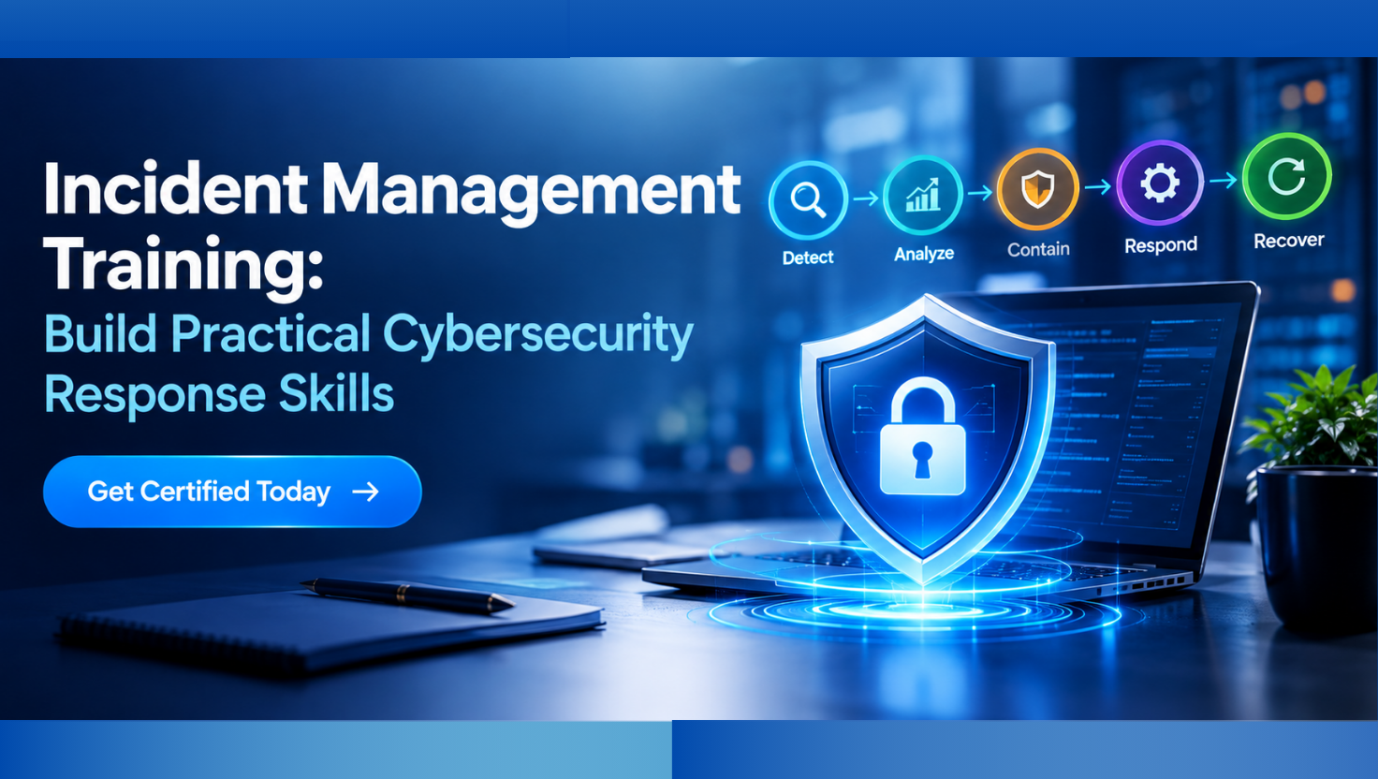
Incident Management Training: Build Practical Cybersecurity Response Skills
Posted on September 17, 2026
Cybersecurity attacks might affect business processes negatively, expose sensitive data, and create significant difficulties during recovery. In light of the increasing complexity of cybersecurity threats, professionals require systematic knowledge and practical skills to deal with such incidents effectively. Incident management training enables professionals to develop the skills needed to identify, analyze, contain, and respond to cybersecurity incidents in a structured manner.
Why Incident Management Matters in Cybersecurity
Incident management is a critical element of cybersecurity in organizations. An incident in this regard could be any of the following: malware attack, ransomware attacks, unauthorized access, account compromise, data leakage, or attack against the organization’s network infrastructure. A lack of incident management procedures often results in wasted time spent by the team to determine the root cause of the attack or the actions needed to take.
The process of incident management should consist of preparation, detection, analysis, containment, eradication, recovery, and improvement. Collaboration of various departments such as security teams, IT staff, managers, legal teams, among others, is required in order to manage incidents properly.
Incident management training helps professionals understand the process of incident management more clearly. Rather than having different approaches to handling each incident, the process can be standardized through procedures, plans, handling evidence, and escalation, among others.
What Does Incident Response Training Cover?
Incident Response Training is aimed at the acquisition of skills needed for dealing with cybersecurity incidents. The training may touch upon a wide variety of topics, including incident response basics, threat detection, malware analysis, ransomware response, forensics, containment, and remediation.
Such programs as the PECB Certified Incident Responder (CIR) offer training in strategic incident handling, ransomware and malware incident response, perimeter threat detection and response, persistence, forensics, and continuous improvement. This program uses exercises for applying the acquired knowledge in real security situations.
Such training is especially useful for those who should deal with security incidents in organizations. This training will provide information about not only the nature of the incident itself but also the way of coordinating the reaction under certain pressure conditions.
Key Skills Professionals Can Develop
The well-structured cybersecurity incident response program may aid in the development of various abilities among the professionals.
1. Incidence Detection and Analysis
Timely incidence detection can provide professionals with information on the nature of the detected anomaly and whether it is related to any security incident. Professionals get knowledge on how to analyze the indications of compromise, investigation of the suspicious activity and estimation of the scale of the incident.
2. Ransomware and Malware Incident Response
Ransomware and malware may influence the system, application and the business process of an organization. The topics covered in CIR program include vectors of the ransomware attack, the behavior of malware, response to it and its remediation.
3.Containment and Remediation
After the identification of the incident, security teams have to minimize the effect of it.
4. Digital Forensics
The forensic investigation can be useful in providing valuable insights about what took place, how the attack happened, and the systems that may be affected. The response team might need to collect evidence using investigative methods to assist in the technical analysis process.
5.Incident Response Planning
It is useful for companies to have documentation in place prior to any major incidents taking place. The training could be useful in helping the professional learn how to plan and build response plans.
Who Should Consider This Training?
The skills involved in incident response are applicable in various fields in cybersecurity and information technology. PECB CIR training is designed for persons who are part of the incident response team, cybersecurity analysts, IT security professionals, SOC personnel, professionals who are preparing to be incident response experts, and managers who have to develop their incident response strategy.
Incident response knowledge will help governance, risk, and compliance professionals understand how incidents are detected, managed, reported, and improved in terms of technical aspects. Incident response knowledge can also contribute to achieving cybersecurity governance goals.
For those professionals who are already in cybersecurity, incident response training can serve as a guideline that helps them develop incident response knowledge.
Why Practical Learning Is Important
Concepts of cybersecurity are easily applicable to practitioners if they are able to relate theory to practical cases. In incident response, practitioners are required to make decisions in real-time situations that might require investigation, stakeholder coordination, containment, and recovery of the affected systems.
The PECB CIR approach relates theoretical concepts with practical assignments, tests, and case studies. The program curriculum covers incident management strategy, ransomware and malware responses, perimeter threats, persistence, investigation, and continuous improvement.
Such an approach can aid in making professionals not only understand the cybersecurity terminologies but also understand how incident response processes interrelate.
Building a Stronger Incident Response Capability
Incidents need to be addressed on an ongoing basis, rather than as a single event. As threats, technology, and vulnerabilities change, organizations must continuously learn, train, test, review, and enhance their abilities to respond to such incidents.
Another way that professionals can use past incidents is for improving their incident response plans by learning about how incidents were handled, how detection was done, communication processes, and recovery processes.
Conclusion
Incident response is not only about how you react once the cyber-attack happens. You require people that are able to identify risks, analyze incidents, contain the damage, investigate the evidence, coordinate activities related to incident response, and recover from the situation. Proper training will assist you in doing so and preparing yourself as a cybersecurity professional to the new security environment.
In case you wish to develop your technical incident response skills and earn the PECB Certified Incident Responder certificate, we would recommend taking Certified Incident Responder (CIR) Training provided by Make Sense Grc. We offer it along with other cybersecurity certifications training programs.
Want to improve your cybersecurity incident response skills? Try the Certified Incident Responder (CIR) Training program now!
FAQS
1. What is incident management training?
This is professional training that enables trainees to get familiar with how they should be prepared for, detect, analyze, contain, handle, and recover from cybersecurity incidents.
2. Who can benefit from Incident Response Training?
Incident response training can be beneficial to cybersecurity analysts, incident response team members, SOC practitioners, IT security experts, security managers, and individuals transitioning into incident response.
3.What are some of the subjects that Certified Incident Responder Training includes?
Certified Incident Responder Training includes such subjects as basics of incident response, ransomware and malware response, perimeter threats detection, persistence techniques, forensic investigation, and continuous improvement.